What I Care About This Week | 2021 Dec 20

by Franklin J. Parker

The Summary

  • Omicron continues to make headlines, with pandemic measures to be implemented by numerous state and national governments. Investors are worried omicron will dent economic growth, and with inflation running high, there is uncertainty around central bank response. Because inflation has been driven, at least partly, by supply constraints due to Covid, there is debate whether another wave of lockdowns is inflationary, or if it would result in slowing business and consumer spending (disinflationary). Either way, the Fed has repeatedly stated that they would not step in with a change to policy unless the slowdown became clear in the data. In other words, they will not anticipate the effects of another Covid wave, waiting instead for the data to reflect the effects.

  • Tensions with Russia over Ukraine have increased. The US is considering sending military equipment to the border to deter a Russian incursion. Of course, Putin has claimed that they have no designs to take Ukrainian land. As we discussed last week, this has been a foreign policy test for the Biden administration, and is, in many ways, a foreshadowing of a potential US-China tussle over Taiwan.

  • The Federal Reserve announced, in keeping with the expectations they had telegraphed, that they would slow down their money-printing program with the expectation to be done by mid March. While that was notable, the big shift in Fed policy expectations came as the committee indicated the likelihood of three rate hikes in 2022 rather than the originally-expected two. One day post-meeting, one Fed governor even indicated that the March meeting could be “live” for a rate hike—another adjustment to policy expectations. In all, investors have been struggling to anticipate and adjust during this time of transitionary monetary policy.

  • While I do not believe investors should be too concerned, long-term, with the current market dynamics (this is not the end of the economic cycle, so far as I can tell), it could make sense to begin increasing defensive positioning after January/February’s earnings season. From our current vantage point it appears that good news will be hard to come by after that. Again, it seems more probable that next year will give investors a genuine correction in markets, which could be a great entry point for cash, or a great moment to re-align portfolios from defensive to offensive. Investors who “miss it,” however, should not be too concerned as it is likely to be short-lived.

The Details & Charts of the Week

With government spending, inflation, and the role of the Federal Reserve in the news, I thought it timely to take a closer look at interest rates and government debt, and what we can consider sustainable and unsustainable.

Of course, government debt is at an all-time high (first chart below). Though, government debt is always at an all-time high, so this is not a new situation. It has expanded considerably, of course, but what is of more pressing concern is the second chart, which shows the percentage of the federal budget spend on paying for that debt. We have been able to sustain considerably more debt than “normal” because of the third chart: the effective interest rate on government debt at an all-time low.

The ongoing debate, then, is over the third chart. What is sustainable when effective interest rates are less than 2% becomes less sustainable if those rates move to, say, 4%. Based on current debt figures ($28 trillion), a 4% effective rate of interest would force the US Treasury to spend $1.1 trillion per year on just interest payments. To put that into perspective: in 2019 total federal government expenditure was $4.7 trillion.

In other words, if effective interest rates move back to where they were in the early 2000s (not that long ago!), the US government would be spending about 23% of her annual budget on interest payments—more than double what was paid in the 1980s when interest rates were almost 4x higher.

And this is just assuming a return to a long-term average. If the Fed gets aggressive at fighting inflation and effective rates go to 8%, fully half of the federal budget will be consumed with interest payments. That is about the annual military budget of the United States. That appears unsustainable.

All of this matters because it affects how the Federal Reserve can respond to the threat of inflation. Aggressive interest rate hikes are, in reality, off the table. Some other mechanism will have to be used to pull excess cash out of the economy, though exactly what is an open question.

Investors, as I have said many times before, would do well to remain flexible and closely monitor the tug-of-war between policy, inflation, economic growth, and covid. And the sustainability of government spending will affect all of these.

Total Federal Debt.
Percent of Federal Budget Spent on Debt Service.
Effective Interest Rate on Federal Debt.

This document is a general communication being provided for informational purposes only. It is educational in nature and not designed to be taken as advice or a recommendation for any specific investment product, strategy, plan feature or other purpose in any jurisdiction, nor is it a commitment from Directional Advisors to participate in any of the transactions mentioned herein. Any examples used are generic, hypothetical and for illustration purposes only. This material does not contain sufficient information to support an investment decision and it should not be relied upon by you in evaluating the merits of investing in any securities or products. In addition, users should make an independent assessment of the legal, regulatory, tax, credit, and accounting implications and determine, together with their own financial professionals, if any investment mentioned herein is believed to be appropriate to their personal goals. Investors should ensure that they obtain all available relevant information before making any investment. Any forecasts, figures, opinions or investment techniques and strategies set out are for information purposes only, based on certain assumptions and current market conditions and are subject to change without prior notice. All information presented herein is considered to be accurate at the time of production, but no warranty of accuracy is given and no liability in respect of any error or omission is accepted. It should be noted that investment involves risks, the value of investments and the income from them may fluctuate in accordance with market conditions and taxation agreements and investors may not get back the full amount invested. Both past performance and yields are not reliable indicators of current and future results.

What I Care About This Week | 2021 Dec 13

by Franklin J. Parker, CFA

The Summary

  • It is Fed week! The Federal Reserve meets this week, and the stage has been set for an announcement of a quicker end to their money-printing program. This would pave the way for raising interest rates much quicker. The plan that was originally set to end in June of 2022 now appears to be ending in March/April of 2022. This is the new baseline expectation for markets, so any announcement that varies too much from that will likely see markets reprice. In short, all eyes are on the Fed meeting.

  • At 6.8%, inflation is the highest it has been since 1982. The Federal Reserve is obviously concerned with these figures, and has retired the term “transitory” citing ongoing troubles with supply chains, etc, that do not appear to be resolving themselves as quickly as expected. Of course, expanding the money supply by 50% in the last 18 months seems to be conspicuously absent from Fed commentary, but that is why they are suddenly so eager to stop printing money. Another challenge with the inflation story is the ongoing decoupling of the global supply chain from China. China has been a global inflation-absorber for the past 40 years. With that relationship changing, inflation may once again be a concern for policymakers.

  • Biden and Putin spent 2 hours on the phone last week seeking a solution to the escalating Russia-Ukraine tensions (Russia has amassed 90,000+ troops on its border with Ukraine). In addition to natural gas supplies to Europe (of which Russia supplies just over a third) and the obvious concerns over geopolitical stability, Ukraine is likely viewed as a barometer of Western commitment by the Chinese Communist Party. With their eyes on Taiwan, an uncontested Russian invasion of Ukraine would likely be seen by the CCP as a green light for a low-cost/uncontested annexation of Taiwan. While Ukraine would not be of much economic significance to US markets, Taiwan is a major supplier of high-tech components and equipment. So, a CCP-controlled Taiwan would further disrupt supply chains and increase costs and shortages of goods.

  • In sum, my portfolio view has been that the Fed’s money-printing and the ongoing reopening of the economy are pushing risk prices higher. With the Fed winding down that program sooner rather than later, and the reopening of the economy most over, markets may begin to run into a headwind (though probably not until after another earnings season or two). As I have said before, raising interest rates and ending quantitative easing both serve to shrink valuations, but not necessarily prices. By my read, however, late spring may see a significant drawdown in stocks as markets reprice the macroeconomic environment, with a fairly quick recovery afterward. In any event, caution and risk control are warranted.

The Details

A friend of mine, Victor Xing, pushed out a piece last week talking through some points that are often overlooked in discussions of the US-China relationship. When it comes to Taiwan, Victor says, it meets all the criteria for a significant tail-risk event.

The key variable that is often overlooked is the Chinese cultural concern with saving face. Individuals will do seemingly irrational things (like worsen their financial position) to retain their honor and save face. US defense policy, however, tends to overlook this fact. So, by pursuing policy that makes the CCP look bad with regards to Taiwan, US policymakers tend to provoke a reaction that they would not otherwise expect because the CCP is very concerned with saving face, even to their own detriment.

It is my personal and comparably uniformed view that the US lacks the political will to pursue a hot war with our largest trading partner over Taiwan, despite the rhetoric. The economic costs and pain would be significant—for both sides—and “victory” would be about who can tolerate the most economic pain. In that respect, China has significantly more political will than the US. Taiwan is a nice-to-have to the US, but hardly worth losing a presidential election. To China, by contrast, Taiwan is of great strategic importance.

At any rate, investors would do well to watch the decaying US-Chinese relationship closely. With every subsequent erosion in relations, the cost of acquiring Taiwan becomes lower to the CCP. For investors, beyond the standard concerns of war, a Chinese acquisition of Taiwan would turn the supply chains of many of our high-tech goods on their heads.

Chart of the Week

Inflation is a phenomenon with some interesting quirks. One of those quirks is that consumer’s expectations for inflation can influence inflation itself. As this week’s chart shows, when inflation is low, consumers tend to hold a constant view of what future inflation will be. However, when inflation turns higher, consumers tend to assume that higher inflation dominate in the future. This is a big challenge for policymakers because expectation is a variable they cannot control.

This document is a general communication being provided for informational purposes only. It is educational in nature and not designed to be taken as advice or a recommendation for any specific investment product, strategy, plan feature or other purpose in any jurisdiction, nor is it a commitment from Directional Advisors to participate in any of the transactions mentioned herein. Any examples used are generic, hypothetical and for illustration purposes only. This material does not contain sufficient information to support an investment decision and it should not be relied upon by you in evaluating the merits of investing in any securities or products. In addition, users should make an independent assessment of the legal, regulatory, tax, credit, and accounting implications and determine, together with their own financial professionals, if any investment mentioned herein is believed to be appropriate to their personal goals. Investors should ensure that they obtain all available relevant information before making any investment. Any forecasts, figures, opinions or investment techniques and strategies set out are for information purposes only, based on certain assumptions and current market conditions and are subject to change without prior notice. All information presented herein is considered to be accurate at the time of production, but no warranty of accuracy is given and no liability in respect of any error or omission is accepted. It should be noted that investment involves risks, the value of investments and the income from them may fluctuate in accordance with market conditions and taxation agreements and investors may not get back the full amount invested. Both past performance and yields are not reliable indicators of current and future results.

What I Care About This Week | 2021 Nov 29

by Franklin J. Parker, CFA

The Summary

  • Top of mind for investors this week is the omicron Covid variant that popped up toward the end of last week as a serious concern. There is a lot to unpack here, so I will address this in “The Details” below.

  • What is of longer-term concern is the likelihood of the Fed ending quantitative easing and raising rates at a faster pace than previously anticipated (this was discussed last week). Originally, investors had planned an end to QE in June 2022 with rate hikes to begin in the six months following. It now seems equally likely that tapering will be completed in spring of 2022 with rate hikes to follow the rest of the year. This could change if omicron is more impactful than I currently expect.

  • November jobs post on Friday, a key input in the Federal Reserve policymaking. Current expectations are a headline rate of 4.5%, however the participation rate will also be key as people have been leaving the workforce in significant numbers lately. A significant portion of the recent decline in the headline unemployment rate has been workers ending their search for work (and thus no longer being counted in the labor force).

  • I am watching two other pieces of news closely, neither of which are getting much attention in the financial press. The first is the debt ceiling debate. Congress has until December 15 to raise the debt ceiling, and if history is any guide this will come down to the wire. While a small probability, there is always a concern that the negotiations will falter and the US Treasury will be unable to pay interest payments on treasury bonds—financial Armageddon.

    The second is the buildup of tensions between Russia and the Ukraine. Russia has amassed around 90,000 troops on the Ukrainian border, and the Ukrainian president has alleged that Russia had planned a coup to topple the government in Kiev. While not worth significant worry just yet, both news items should be watched closely.

The Details

Omicron is top of mind for investors this week, especially after Friday’s strong selloff. Even though it was only a half-day of trading, volume was on par with the previous few days. Clearly this has spooked investors.

Obviously there is concern about more lockdowns, supply constraints, and lost economic activity. Of course, not nearly enough is yet known to make an assessment of how damaging it could be. My inclination is to expect that it is not particularly noteworthy (Delta also carried the same fear and that fear fizzled), though there are some mutations in this strain that make it more concerning, at least in theory. At the moment, the raw number of cases is not all that concerning, but it is climbing quickly and some 80% of Covid treatments in South Africa are currently the omicron variant.

There are numerous second-order effects that must be considered. The Fed is the first and most obvious. Any sign of Covid-induced economic slowdown is likely to draw a response from central banks around the world. Indeed, investors quickly repriced bonds as well as rate-hike expectations on Friday, showing a move to 2 rate hike expectations for 2022 (rather than the 3 previously). The Fed, in my view, is not likely to respond until any effects are visible in the economic data (unemployment, GDP growth, etc).

Market reactions were very knee-jerk and, in my view, not particularly nuanced. Friday was a “sell first ask questions later” response. In addition to the Fed likely offsetting any significant pain from Covid-induced disruptions, I also do not see the political will (in the US) for 2020-style largescale lockdowns. That isn’t to say there would be no disruption, of course. Rather, I am pointing out that investors should have little worry for a 2020-style market selloff because the Fed is in play and lockdowns are considerably less likely. If the chart above communicates anything, it is that these Covid waves are disruptive, but not catastrophic.

In the end, I sense that the market downswing from Friday is likely not done, but that it is likely to be short-lived, and not as dramatic as March 2020. Investors can and should use it as an entry point for cash, and otherwise pay it little mind. Of course, further developments may well change my view.

Chart of the Week

A look at new Covid cases versus the S&P 500 shows a rough relationship between rising cases and poor S&P 500 performance. What we find, though, is that markets tend to price the new wave well ahead of the peak. I would expect similar behavior this time around. If omicron is to become a new wave of cases, markets will price that in advance of the worst, and begin their recovery just as the peak is occurring.

This document is a general communication being provided for informational purposes only. It is educational in nature and not designed to be taken as advice or a recommendation for any specific investment product, strategy, plan feature or other purpose in any jurisdiction, nor is it a commitment from Directional Advisors to participate in any of the transactions mentioned herein. Any examples used are generic, hypothetical and for illustration purposes only. This material does not contain sufficient information to support an investment decision and it should not be relied upon by you in evaluating the merits of investing in any securities or products. In addition, users should make an independent assessment of the legal, regulatory, tax, credit, and accounting implications and determine, together with their own financial professionals, if any investment mentioned herein is believed to be appropriate to their personal goals. Investors should ensure that they obtain all available relevant information before making any investment. Any forecasts, figures, opinions or investment techniques and strategies set out are for information purposes only, based on certain assumptions and current market conditions and are subject to change without prior notice. All information presented herein is considered to be accurate at the time of production, but no warranty of accuracy is given and no liability in respect of any error or omission is accepted. It should be noted that investment involves risks, the value of investments and the income from them may fluctuate in accordance with market conditions and taxation agreements and investors may not get back the full amount invested. Both past performance and yields are not reliable indicators of current and future results.

What I Care About This Week | 2021 Nov 22

by Franklin J. Parker, CFA

The Summary

  • We have an abbreviated trading week due to Thanksgiving, and this is a light data week. Durable goods and initial jobless claims post on Wednesday, both should give insight into the pace and power of the recovery. The debt ceiling is again in the news, as Treasury Secretary Janet Yellen cautioned lawmakers that the ceiling should be raised by early December. That said, analysts wouldn’t expect Treasury to run out of cash until January. Were it me, I wouldn’t risk it, but lawmakers tend to use these moments to broker 11th-hour deals. Another push to the redline is not off the table.

  • Retail sales were strong last week, a signal that the US consumer is still in the game, despite higher prices and an end to most pandemic aid programs. This data was backed up by earnings reports from Target and Walmart—both showing strong same-store sales growth. There is concern that supply bottlenecks will throttle holiday spending in Q4, so investors should watch the developing data closely. The Atlanta Fed’s GDPNow indicator (which attempts to estimate current GDP growth from current data), got a strong boost after the announcement.

  • The Biden administration announced that they will nominate current Federal Reserve Chairman Powell for a second term as chair, despite objections from the progressive wing of the Democrat party. Markets rallied after the announcement (remember, more than almost anything markets like stable and predictable policy). Additionally, it appears ever-more likely that the Fed will accelerate the timetable for ending their ongoing money-printing program. Currently, it is scheduled to end around June, but many policymakers have indicated they are open to a quicker timeline in the face of higher-than-expected inflation.

  • It has been my general view that a correction is likely when the Fed stops printing money and markets begin to price-in interest rate hikes. Originally, the timetable for this shift was in the Summer of 2022, however recent rumblings indicate this may be more in the Spring. In any case, investors would do well to keep an eye on the data and comments from the Fed as they develop, as these are variables that have driven a significant portion of market returns for the past 18 months (though one could argue the past decade). I do not expect this to be the end of the economic expansion, so it is likely a good place for investors with a longer time horizon to deploy cash. Of course, my view will update as new data comes in.

This week’s update is abbreviated due to the Thanksgiving holiday.

What I Care About This Week | 2021 Nov 15

by Franklin J. Parker, CFA

The Summary

  • The big news in markets at the moment is last week’s inflation print, which was much higher than expected at 6.2% year-over-year. Everything was a contributor, but energy (+30%), used cars and trucks (+26%), durables (+13%), and food (+5.3%) stood out. Clearly, these levels of inflation are concerning, and it is sure to draw the attention of the Biden administration. As we have talked about here before, there is a growing worry that the Fed simply does not have the tools to fight runaway inflation like they did in the 1980s. Investors should watch data in the coming months very carefully. If inflation begins to abate, this all may be a false alarm. If it continues to increase, then Fed reactions will need to be anticipated. Last week’s treasury auction also indicated that markets may finally be capitulating to higher inflation. The 10-year US Treasury yield spiked from 1.46% to 1.59% on Wednesday, and has now climbed above 1.6%.

  • This week is a fairly quiet week in data. Retail sales post tomorrow and initial jobless claims post on Thursday. Jobs have been a curiosity lately. On the one hand, job openings are at an all-time high, yet the labor-force participation rate (the number of people looking for or who are in jobs, relative to the population) has continued to fall. Exactly why people are choosing not to work is an ongoing debate. For investors, this gives reason to believe that supply shortages may continue as companies struggle to fill positions and deliver goods and services, which, of course, further drives inflation but also slows economic growth.

  • My thesis has been that markets likely have until early summer of 2022 before a significant pullback. With inflation running much hotter, my timetable may get pushed into the spring of 2022. The Fed may need to taper more quickly than originally anticipated so that they can raise interest rates more quickly than previously thought. This could put markets repricing interest rate hikes sooner rather than later. At any rate, investors should watch for developments here with eagle eyes.

The Details

Consumer spending data posts this week. Investors will be watching this data quite closely to see how consumers are coping with higher prices and the end to pandemic-era stimulus. To date, consumers have largely shrugged off higher prices, choosing to maintain and slightly increase spending. Some of that, however, may be due to increased savings from stimulus checks (and rent breaks, and student loan payment suspensions, etc). It is estimated that most of that savings would be depleted by the end of December, however, so some consumer demand may wane in anticipation of lowered savings levels.

And, of course, the Christmas shopping season is also upon us. There is talk that consumers are planning to front-load their Christmas shopping in anticipation of shortages in gift items. Again, fewer goods to sell means retailers may struggle to grow spending over last year at levels that would otherwise be expected, so this is one way supply shortages (and labor shortages) can curtail economic growth.

These monthly data releases—inflation, consumer spending, and employment levels—are becoming more and more important as a gauge for economic activity. Watching these signals closely will help inform the pace of Fed activity, as well as help to forecast earnings in the coming quarters. Disappointing consumer spending would likely yield disappointing Q4 results for many S&P 500 companies.

Chart of the Week

Fathom consulting pushed out an interesting chart this morning. As it turns out, most countries with a per capita GDP of at least half the US are democracies. The plot below shows how democratic a country is on the x-axis and its per capita GDP relative to the US on the y-axis. China is highlighted in blue. With “the great decoupling” under way, analysts are warning that Chinese growth may not be the bet it used to be. Stacked on top of that is the centralized economic control exerted by the CCP. Without a more liberal economy, the Chinese state-capitalism model may be put to a real test.

This document is a general communication being provided for informational purposes only. It is educational in nature and not designed to be taken as advice or a recommendation for any specific investment product, strategy, plan feature or other purpose in any jurisdiction, nor is it a commitment from Directional Advisors to participate in any of the transactions mentioned herein. Any examples used are generic, hypothetical and for illustration purposes only. This material does not contain sufficient information to support an investment decision and it should not be relied upon by you in evaluating the merits of investing in any securities or products. In addition, users should make an independent assessment of the legal, regulatory, tax, credit, and accounting implications and determine, together with their own financial professionals, if any investment mentioned herein is believed to be appropriate to their personal goals. Investors should ensure that they obtain all available relevant information before making any investment. Any forecasts, figures, opinions or investment techniques and strategies set out are for information purposes only, based on certain assumptions and current market conditions and are subject to change without prior notice. All information presented herein is considered to be accurate at the time of production, but no warranty of accuracy is given and no liability in respect of any error or omission is accepted. It should be noted that investment involves risks, the value of investments and the income from them may fluctuate in accordance with market conditions and taxation agreements and investors may not get back the full amount invested. Both past performance and yields are not reliable indicators of current and future results.

What I Care About This Week | 2021 Nov 8

by Franklin J. Parker, CFA

The Summary

  • Last week was the FOMC meeting. No surprise, the Fed left interest rates unchanged and began tapering. Rather than print $120 billion in November, they plan to print $100 billion, and then print a little less each month until they are at $0 by next June. This is more-or-less in-line with market expectations. Markets popped, but more on the much more dovish tone of the Fed—rather than feel pushed by recent inflation figures, Chairman Powell said that they will be patient and let many of the factors in the supply chain work themselves out. In essence, anything that is a temporary price hike will be viewed as “transitory” by the Fed.

  • Jobs posted on Friday of last week considerably stronger than expected (531,000 jobs added vs 450,000 expected, plus some upward revisions of previous data). Normally, I would have expected this to trigger a “good-news-is-bad-news” move in markets, but because central banks indicated they are willing to be very patient, markets rallied. It makes sense: with the Fed in play and the economy gaining steam, markets are pricing both growth and easy cash.

  • Earnings season is mostly now behind us with 89% of S&P 500 companies having reported earnings for Q3. The S&P 500 companies are reporting earnings growth of around 39% year-over-year. This week, then, investors will be watching some key data on the fundamentals of the economy. Producer prices (a common measure of inflation) are due on Tuesday, and core CPI (the headline measure of inflation) is due out Wednesday. While most analysts expect these figures to be high, the report on why they are high will be important (i.e. is the effect “transitory” or permanent?) because that will help inform the Fed’s response.

  • Just to reiterate, my view is that markets will trade higher up to late spring of next year, fueled by ongoing central bank activity and economic reopening. By summer of 2022, however, the Fed will be done printing money and markets will begin pricing rate hikes, plus the reopening trade will have subsided. It seems likely to me that the summer of next year will be rocky, given those forces, and investors may do well to be prepared. Of course, there are risks to this view, not the least of which is how inflation evolves over coming months. As I have said many times before, flexibility is among the most important skills in this environment.

The Details

I spent some time analyzing the price returns of bitcoin late last week. Partly because I field lots of questions on the topic, but also because the nature of a financial asset’s return distribution is a major contributor to the role it plays in an overall portfolio.

Now, I don’t want to get too technical here. Suffice it to say, in portfolio construction, returns are assumed to be statistically normal (remember that bell curve from college? That is the “normal” curve). This assumption, while not true in practice, is close enough to allow us to use some tools to mix and match investments in a reasonable way.

However, when we look at the daily returns of bitcoin, what we find is that returns are not even close to the normal distribution (in the chart below, blue is statically normal, and red is bitcoin’s actual distribution).

Daily returns of bitcoin since 2014, compared to normal distribution.

What we find is that not much happens considerably more often than we would expect, and huge moves—both up and down—happen much more often than we would expect. The problem with this is that it evades our intuition of how financial assets behave. In short, our experience investing in other assets does not well inform our experience in bitcoin.

There are, of course, models which do closely match bitcoin’s actual return distribution, but those models are not well behaved. In fact, we currently have almost no tools for building portfolios of assets with distributions like that! That said, we can use the model to generate some future expectations for the asset, namely its risk profile. Given the parameters of the observed data, we should expect a 1-day loss of:

  • 10% about 7 days in every year.
  • 20% about 3 days in every year.
  • 30% about 1 day every year, and
  • 50% or more about 1 day every other year!

In short, bitcoin is a tough asset to place in a portfolio—we don’t really have tools to know how much to buy, when to buy, etc. Moreover, it has the potential to realize considerable losses—the worst of which have yet to be seen! Given that the worst 1-day return of bitcoin has been 37% since 2014, there are some really bad days not seen in the historical data, but which are predicted by the distribution model.

Of course, good days can happen, too (about the same metrics apply to the upside of the distribution), and that is the exciting part.

My advice is what it has always been: bitcoin is a bit of a gamble, so you should only invest what you can afford to lose!

Chart of the Week

One interesting outcome of the Covid recession has been that incomes have jumped for lower-income workers. The bottom and penultimate quartile of incomes saw higher gains over the past year while the highest and second-highest quartile of incomes saw smaller gains over the past year. While a stark increase, this has been part of a larger trend—lower-income-earners have seen their wages rise faster than higher-income-earners since about 2016. This is the first time that has happened since the 1990s.

This document is a general communication being provided for informational purposes only. It is educational in nature and not designed to be taken as advice or a recommendation for any specific investment product, strategy, plan feature or other purpose in any jurisdiction, nor is it a commitment from Directional Advisors to participate in any of the transactions mentioned herein. Any examples used are generic, hypothetical and for illustration purposes only. This material does not contain sufficient information to support an investment decision and it should not be relied upon by you in evaluating the merits of investing in any securities or products. In addition, users should make an independent assessment of the legal, regulatory, tax, credit, and accounting implications and determine, together with their own financial professionals, if any investment mentioned herein is believed to be appropriate to their personal goals. Investors should ensure that they obtain all available relevant information before making any investment. Any forecasts, figures, opinions or investment techniques and strategies set out are for information purposes only, based on certain assumptions and current market conditions and are subject to change without prior notice. All information presented herein is considered to be accurate at the time of production, but no warranty of accuracy is given and no liability in respect of any error or omission is accepted. It should be noted that investment involves risks, the value of investments and the income from them may fluctuate in accordance with market conditions and taxation agreements and investors may not get back the full amount invested. Both past performance and yields are not reliable indicators of current and future results.

What I Care About This Week | 2021 Nov 1

by Franklin J. Parker, CFA

The Summary

  • A little over half of the S&P 500 companies have reported earnings for Q3, and so far the news is quite good. Companies are beating their expectations by a pretty healthy margin, and analysts have been revising their Q4 estimates up, a bullish signal (historically, analysts revise estimates down in the first month of the new quarter). Energy has been the winning sector for revenue growth, although that should be little surprise given where energy prices were in 2020. Materials are a close second, with revenue growth of over 30%. Utilities and consumer staples have been the laggards, though they are still reporting growth. The winner/loser pattern is indicative of an inflationary environment—commodity producers tend to outperform while consumer producers (especially discretionary sectors) tend to lag as consumers moderate spending in the face of higher prices.

  • It is jobs week! Friday we get the unemployment report. Increasingly, the actual headline figures are less important than the details of the report. Investors will be especially watching the number of people leaving the labor force (defined as no longer looking for work). Last month, this was a significant driver of the lower headline unemployment rate. Obviously, these figures influence not just the broader economy, but also the Federal Reserve response. Fewer workers means supply constraints may last longer than they otherwise would (because fewer people are making and moving stuff), it also means a smaller customer base for goods and services.

  • Historically, when fighting inflation, the Federal Reserve raises interest rates. Famed investor Stanley Druckenmiller pointed out the obvious a few weeks ago. If interest rates come back to just their long-run average of 4.9%, the US Government would be spending some 30% of the annual budget on interest payments alone (I have not confirmed his calculations). The Fed, then, may well be constrained in their ability to raise interest rates as it could force spending austerity with congress. It is an interesting thought—how exactly will the Fed fight inflation without the use of their traditional tools? That is a question that has considerable impact on our investment decisions, and it is a question I am wrestling with on an ongoing basis.

The Details

Earlier this year, I published an inflation playbook—a look at where inflation bites hardest and where it creates opportunity. Interestingly, as inflation has developed through the year, we have begun to see some of this play out. This is an indication that investors are repricing their inflation expectations in anticipation of it being with us for a while.

What should investors do, then, in an inflationary environment?

In general, bonds take a beating when inflation expectations increase. Of course, the bond market is a big place. High-quality, long-term bonds are typically the hardest-hit in such an environment. Floating rate bonds and short-term bonds usually hold up much better. A tilt away from the former and toward the latter is warranted in this environment.

For stocks, we typically see energy, commodity-producers, and financials benefit the most from rising inflation expectations. From a bigger perspective, we see a preference for small and mid-size companies over large companies, though large companies hold up fairly well. The caveat to this is technology, which may have trouble coping with higher interest rates, and technology is the biggest percentage of most large-cap indices.

Commodities, of course, perform well. However, gold, despite the popular narrative, does not move in response to inflation nearly as much as other commodities, like industrial metals, foodstuffs, or energy. Commodities are volatile, and it is difficult to gain direct exposure (most funds are based on commodity futures). Even so, an overweight to commodities is not unreasonable in this environment.

Of course, your goals will dictate which risks you should take on in your portfolio—these are only generalizations. But, keeping up with the big-picture is important during a time when the economy and markets are undergoing some big shifts.

Chart of the Week

This week’s chart comes courtesy of the Wall Street Journal, showing the share of the US population that is retired. As the chart clearly shows, Covid accelerated the number of retirees, bumping the number above the five-year trend. This is both good news and bad news. Bad news because it means there are fewer experienced workers in the workforce to help alleviate supply constraints and wage costs. It is good news because one central challenge over the past decade has been the inability of younger workers to move up in their careers due to older workers maintaining their senior positions for much longer. With older workers retiring, younger workers are now able to backfill those positions, and a sense of upward mobility can be maintained.

This document is a general communication being provided for informational purposes only. It is educational in nature and not designed to be taken as advice or a recommendation for any specific investment product, strategy, plan feature or other purpose in any jurisdiction, nor is it a commitment from Directional Advisors to participate in any of the transactions mentioned herein. Any examples used are generic, hypothetical and for illustration purposes only. This material does not contain sufficient information to support an investment decision and it should not be relied upon by you in evaluating the merits of investing in any securities or products. In addition, users should make an independent assessment of the legal, regulatory, tax, credit, and accounting implications and determine, together with their own financial professionals, if any investment mentioned herein is believed to be appropriate to their personal goals. Investors should ensure that they obtain all available relevant information before making any investment. Any forecasts, figures, opinions or investment techniques and strategies set out are for information purposes only, based on certain assumptions and current market conditions and are subject to change without prior notice. All information presented herein is considered to be accurate at the time of production, but no warranty of accuracy is given and no liability in respect of any error or omission is accepted. It should be noted that investment involves risks, the value of investments and the income from them may fluctuate in accordance with market conditions and taxation agreements and investors may not get back the full amount invested. Both past performance and yields are not reliable indicators of current and future results.

What I Care About This Week | 2021 Oct 25

by Franklin J. Parker, CFA

The Summary

  • Investors will be watching this week for earnings from several big-name companies across various industries. Facebook reports today, Google, 3M, Eli LIlly, General Electric, Twitter, Texas Instruments, and many others report later in the week. Needless to say, there will be plenty for investors to digest this week. Many CEOs are addressing questions of supply constraints, inflation, labor shortages, and whether demand has slowed. Per usual, earnings guidance will be important. So far, earnings have been quite strong, with total earnings growth for the quarter expected to be around 30%+.

  • On Friday, Fed chairman Powell made a nod to both tapering asset purchases in November and that supply constraints are keeping prices elevated for longer than they anticipated. He said, “the Fed will need to makes sure our policy is positioned for a range of possible outcomes.” In other words, all past and future guidance should be taken with a grain of salt. This may mean tapering faster than previously anticipated. Faster-than-anticipated Fed action may mean markets price interest-rate hikes sooner rather than later—what was a summer-ish downswing could be a springtime downswing. Again, flexibility and adaptability will be key over the coming years.

  • Inflation has been on the minds of investors and executives, with large companies like Nestle, P&G, and Chipotle saying they plan to continue raising prices in response to higher input costs (labor, transportation, and raw materials). To date, higher prices have not deterred US consumers, although some consumption may be from people buying things today in anticipation that they will be more expensive in the future. Energy companies are reaping gains from higher oil and natural gas prices. Inflation is a legitimate concern for investors, for many reasons, not the least of which is curtailed consumer demand and the response of the Federal Reserve. Keeping a close eye on the developing figures is sensible.

The Details

With the Fed now contemplating a policy response to what can be described as high inflation figures, investors need to have some concept of what tools the Fed will use to combat it. Though expressed through various specific mechanisms, the Fed actually has two tools to control inflation:

  • the amount of money it keeps in circulation and
  • how fast that money can move around.

Slowing either of these slows inflationary pressure, at least in theory. Supply constraints are outside of the Federal Reserve’s control, and there is little they can do about that.

First, and most obvious, the Federal Reserve can push interest rates higher, namely the Federal Funds rate. The Fed Funds rate is the rate is pays member banks to put cash on deposit with the Federal Reserve. By paying a higher rate to take deposits, banks pull cash out of the economy via deposits, then place that cash with the Federal Reserve. By offering an attractive investment to banks other than loans, the Fed is pulling cash out of the economy, hence it is the first tool.

Second, the Federal Reserve can sell assets from its balance sheet (like US Treasuries or mortgage securities) back into the marketplace. When banks buy these securities, they trade cash and the ability to make loans for them. This serves to pull cash from banks and the broader economy. Of course, selling bonds into the marketplace pushes interest rates across the economy higher, and higher rates slow the number of loans being made. This mechanism, then, applies both tools.

Third, the Federal Reserve can adjust bank reserve requirements. Reserve requirements are the amount of cash a bank must keep on hand relative to each type of loan it makes. We can think of this tool as a cash multiplier—the less banks are required to keep in reserve, the more cash they have to lend out. In 2020, the Fed removed all reserve requirements for banks. While considerably less well known, this tool has considerable power to change the flow of cash in the economy. By increasing reserve requirements, the Fed decreases a bank’s ability to make loans thereby slowing the velocity of money through the economy.

How the Fed responds to higher inflation has direct bearing on investment portfolios. Less cash in the economy means lower asset prices, all else being equal. Higher interest rates also curtails corporate earnings growth, all else equal. And higher rates tends to slow consumption (consumers spend more on debt service and housing).

A close eye on Fed policy is required as we transition to a more “normal” policy. Though, it may well be that the Fed cannot fully transition back, and that would be important to observe, as well.

Chart of the Week

Our intuition would tell us that higher prices would slow retail sales, but that has not been the case. Sometimes inflation can show up as increased consumer spending (as people spend more money on the same goods and services). However, as the chart below demonstrates, this may not be the case in our current environment. It appears that higher retail sales came first, and inflation came after. This may mean that increased demand is fueling inflation—at least partly. If that is the case, inflation may well be out of the Federal Reserve’s control.

This document is a general communication being provided for informational purposes only. It is educational in nature and not designed to be taken as advice or a recommendation for any specific investment product, strategy, plan feature or other purpose in any jurisdiction, nor is it a commitment from Directional Advisors to participate in any of the transactions mentioned herein. Any examples used are generic, hypothetical and for illustration purposes only. This material does not contain sufficient information to support an investment decision and it should not be relied upon by you in evaluating the merits of investing in any securities or products. In addition, users should make an independent assessment of the legal, regulatory, tax, credit, and accounting implications and determine, together with their own financial professionals, if any investment mentioned herein is believed to be appropriate to their personal goals. Investors should ensure that they obtain all available relevant information before making any investment. Any forecasts, figures, opinions or investment techniques and strategies set out are for information purposes only, based on certain assumptions and current market conditions and are subject to change without prior notice. All information presented herein is considered to be accurate at the time of production, but no warranty of accuracy is given and no liability in respect of any error or omission is accepted. It should be noted that investment involves risks, the value of investments and the income from them may fluctuate in accordance with market conditions and taxation agreements and investors may not get back the full amount invested. Both past performance and yields are not reliable indicators of current and future results.

What I Care About This Week | 2021 Oct 18

by Franklin J. Parker

The Summary

  • Chinese growth slowed quite a bit in the most recent quarter. After expanding at an annualized 7.9% in the second quarter, the Chinese economy grew at a paltry 4.9% in the third quarter. Numerous variables have been cited for the slowdown, but the relevant point for US investors is how this affects global growth. With China turning in considerably slower figures, there is question about whether the US and Europe will also begin posting worsening figures.

  • This week sees a few important data drops: industrial production today, several Federal Reserve presidents speak, and weekly initial jobless claims post on Thursday, per usual. Of most importance to investors is corporate earnings. With the global growth in question, and the Fed expected to begin tapering asset purchases come November, corporate earnings stand to be a catalyst, either for higher prices or lower. To date, 8% of S&P 500 companies have reported earnings, and of those, most have reported positive surprises, a good sign so far.

  • My view is that markets will likely continue trading sideways for the next couple of weeks. With positive earnings, I see investors again pushing prices higher, at least through the first half of next year, though inflation remains a significant risk to investors. It is the summer of next year that I see getting dicey—interest rate increases have historically created downside for markets, and that is about the time markets will be pricing them. For now, our portfolio strategy is to use dips to deploy cash, and remain steady-as-she-goes otherwise.

The Details

I’ve been writing a book.

The book is a technical manual on goals-based portfolio theory, which has been a serious topic of my research over the past several years. It isn’t ready yet (I’ll let you know when, don’t worry), but what it has forced me to do is consider the many of the implications of a goals-based approach. The one that stood out to me last week was how goals-based investors approach markets, and how markets might go about discovering price (I have talked about this before).

In a world where investors are trying to accomplish specific goals, market pricing looks entirely different. Contrary to accepted theory, market pricing is reflective, not just of the financial fundamentals of a business, but also what it is the investors themselves are trying to achieve. By viewing investments through a goals-based lens, investor pricing (and therefore price discovery) shifts considerably.

Last week, I spent time analyzing how goals-based investors might approach portfolio hedging. Similar to how investors price other securities, my research shows that individuals are willing to pay different prices for the exact same hedge. This is no surprise to investors and practitioners, of course, as it squares with our intuition. However, to date, these intuitions have been generally considered irrational by traditional economic theory.

My genuine hope is that this research not only helps real people organize investments in such a way as to better achieve real goals in life, but also that broader economic theory would begin to accept that people are not quite as irrational as we have been led to believe!

Stay tuned, there is more to come.

Chart of the Week

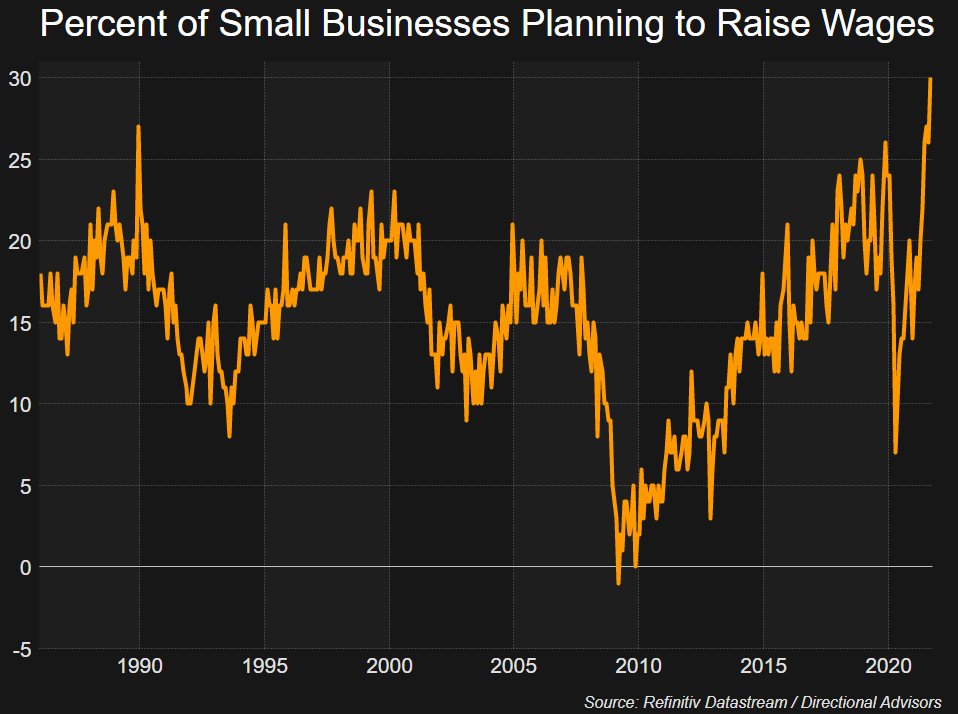
Inflation was the big news last week. Though in-line with expectations, 5.4% inflation is high by anyone’s standard. What’s more, it is getting harder and harder to argue that all of this is just transitory.

This week’s chart shows the percentage of small businesses who are planning to raise wages in the coming months. As we can see, this is the highest figure in 30+ years. While a positive for workers, higher wages are passed along through higher prices so small business wage increases are likely to further fuel inflation pressures. The danger is we become trapped in a wage-price spiral where rising inflation pushes wages higher, which in turn pushes inflation higher.

This document is a general communication being provided for informational purposes only. It is educational in nature and not designed to be taken as advice or a recommendation for any specific investment product, strategy, plan feature or other purpose in any jurisdiction, nor is it a commitment from Directional Advisors to participate in any of the transactions mentioned herein. Any examples used are generic, hypothetical and for illustration purposes only. This material does not contain sufficient information to support an investment decision and it should not be relied upon by you in evaluating the merits of investing in any securities or products. In addition, users should make an independent assessment of the legal, regulatory, tax, credit, and accounting implications and determine, together with their own financial professionals, if any investment mentioned herein is believed to be appropriate to their personal goals. Investors should ensure that they obtain all available relevant information before making any investment. Any forecasts, figures, opinions or investment techniques and strategies set out are for information purposes only, based on certain assumptions and current market conditions and are subject to change without prior notice. All information presented herein is considered to be accurate at the time of production, but no warranty of accuracy is given and no liability in respect of any error or omission is accepted. It should be noted that investment involves risks, the value of investments and the income from them may fluctuate in accordance with market conditions and taxation agreements and investors may not get back the full amount invested. Both past performance and yields are not reliable indicators of current and future results.

What I Care About This Week | 2021 Oct 11

by Franklin J. Parker, CFA

The Summary

  • Earnings season is upon us! The next four weeks or so, investors will be able to digest how companies are handling everything from the Covid resurgence, to the difficulty finding labor, to increased costs due to inflation, to supply shortages. Many analysts are predicting slower earnings growth, though that is not particularly noteworthy after last quarter’s blockbuster gain. All in, earnings are expected to grow a little over 27% for the quarter. This week, JP Morgan, Delta Airlines, and United Health Group, report earnings, along with several others.

  • Lawmakers reached a deal to extend government funding to December. This is a bit of can-kicking, but markets welcomed the news. I was a bit surprised how much the debt ceiling debate was weighing on investor minds—it happens all the time, the brinksmanship is nothing new, and lawmakers always figure it out at the last minute. Of course, the risk is not zero that they fail to figure it out in time, and a default on US Treasury debt would be catastrophic for financial markets. So, we will pick the issue up again in late November.

  • The jobs report for September was a big disappointment. Though the headline figure dropped to 4.8%, the drop was entirely due to people leaving the workforce rather than from jobs filled. There is a confusing dichotomy at the moment. The US has 2.75 job openings for every one unemployed person, yet these jobs are not being filled. Before the end of extended unemployment benefits the argument was that people were paid more if they did not work than if they did, but we have not seen a rush to fill job openings as these extended benefits expired (though the next jobs report will have the final say on that point). It is just another odd paradox of the current economic environment.

  • The recent market pullback has held in-line with my expectations. As I mentioned before, this does not appear to be a major risk-off event. Rather, this appears to be some sideways trading as investors reprice the Fed and await earnings. If I had to guess—emphasis on guess—I would say that current prices are near or at the top of the sideways trading range. I think we may see prices fall before they rise again. My expectation is that the real move higher begins in early November, but, clearly, I will be watching the data closely. Again, for long-term investors, this is not worth taking tax consequences to avoid.

The Details

The Biden Administration has tightened many of the tariffs on goods imported from China. Companies and investors who hoped for a change of policy after Trump’s trade war have been quite disappointed. The Office of the US Trade Representative has said it would consider granting tariff waivers for 549 product categories—only about 25% of the number of categories exempted by the Trump administration.

Investors have been dealing with the China trade war for some time. However, it is becoming clear (if it wasn’t already), that decoupling from China is now a bipartisan consensus. I have talked here before about some of the consequences. It might be time to review some of them.

First, and most critically, the Chinese Communist Party (CCP) is not eager to allow US companies to sell goods and services into their consumer market. China is the largest consumer market in the world, so companies unable to operate there face a significant growth ceiling. Apple and Google, to name just two, have made concessions to the CCP in order to be allowed to operate there, but not all companies are willing or able to do so.

Second, China’s manufacturing capacity has been the world’s inflation absorber for the past 30 years. Companies facing higher costs for raw materials and labor have been able to lower costs by sending their manufacturing to China. This has kept consumer prices considerably lower than they otherwise would have been for the past 30 years. A decoupling from China is likely to create upward pressure on prices (some of which we have already seen), though some companies will be able to shift to other places in developing Asia.

Third, China has been as dependent on US businesses as the US has been on Chinese manufacturing. As the two decouple, the risk of conflict escalates. Taiwan becomes a notable example. A few days ago, President Xi announced his desire to seek “peaceful reunification” with Taiwan. US foreign policy with respect to Taiwan has been largely built on ambiguity: neither power is certain what the US would do if China tried to invade the island. With less to lose in a military conflict, the possibility of a conflict, or a proxy conflict, increases.

The merits and demerits of decoupling from China can and will be debated. My purpose here is not to argue for one or the other. Rather, investors should prepare portfolios for the ongoing decoupling between China and the US, and that may turn the tables on winners and losers.

Chart of the Week

I heard a veteran bond manager speak at a CFA event last week. He was quite convincing that 10-year US Treasury yields could reach 3.75% in the near future. While bond investors have mostly insulated themselves from such a dramatic rate rise, equity investors appear to be pretty complacent about this possibility. Many equity sectors could be badly bruised if rates begin to run away. P/E ratios would be the first to contract (which has already begun), but tech and real estate stocks stand to get hurt the most. I would expect other stocks to help make up the difference: namely bank stocks and other financials. Higher rates means more profit for traditional financial businesses.

This document is a general communication being provided for informational purposes only. It is educational in nature and not designed to be taken as advice or a recommendation for any specific investment product, strategy, plan feature or other purpose in any jurisdiction, nor is it a commitment from Directional Advisors to participate in any of the transactions mentioned herein. Any examples used are generic, hypothetical and for illustration purposes only. This material does not contain sufficient information to support an investment decision and it should not be relied upon by you in evaluating the merits of investing in any securities or products. In addition, users should make an independent assessment of the legal, regulatory, tax, credit, and accounting implications and determine, together with their own financial professionals, if any investment mentioned herein is believed to be appropriate to their personal goals. Investors should ensure that they obtain all available relevant information before making any investment. Any forecasts, figures, opinions or investment techniques and strategies set out are for information purposes only, based on certain assumptions and current market conditions and are subject to change without prior notice. All information presented herein is considered to be accurate at the time of production, but no warranty of accuracy is given and no liability in respect of any error or omission is accepted. It should be noted that investment involves risks, the value of investments and the income from them may fluctuate in accordance with market conditions and taxation agreements and investors may not get back the full amount invested. Both past performance and yields are not reliable indicators of current and future results.

Exit mobile version
%%footer%%